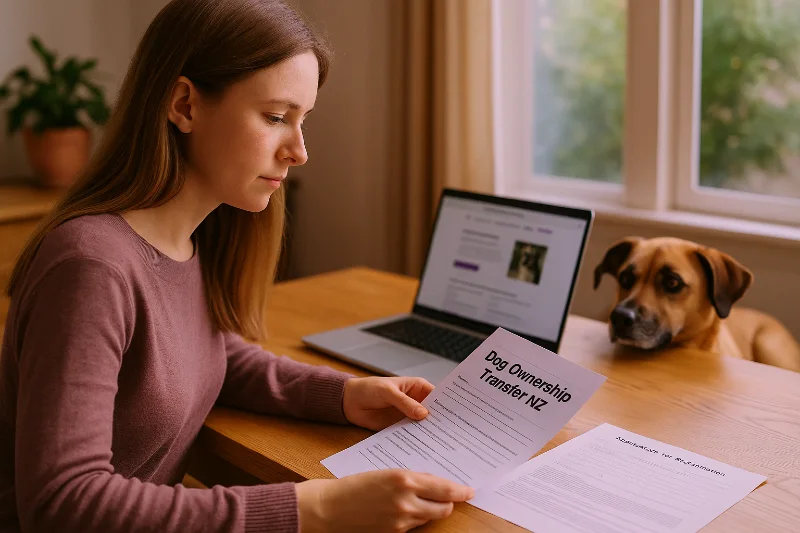
Legal Things to Know Before Rehoming a Dog in NZ
Rehoming a dog in New Zealand isn’t just an emotional decision — it’s a legal one.
Before listing your dog on Pet Rescue NZ, it’s vital to understand your responsibilities under New Zealand law, including the Animal Welfare Act 1999, Dog Control Act 1996, and your local council regulations.
This guide explains what every owner must know about dog rehoming laws NZ, covering ownership transfers, microchipping, vaccinations, and how to stay compliant while protecting your dog’s welfare.
1. Why Legal Understanding Matters
When you transfer a dog to a new owner, you are not just “giving them a pet.” You are transferring legal responsibility for a living animal.
Why that matters:
- Until you complete certain steps (council notification, microchip updates, proof of transfer), you are still legally considered the owner, even if the dog is physically with someone else.
- If the dog bites someone, causes property damage, is found roaming, or is seized by animal control — and you haven’t officially transferred ownership — you can still be contacted, fined, or held responsible.
- Under the Animal Welfare Act 1999, failing to meet basic care and welfare standards can result in fines of up to $5,000, and in more serious cases imprisonment for up to 12 months, even if you were “about to rehome the dog.”
So: rehoming is a legal handover, not just “dropping the dog off.”
This also matters to adopters. A good adopter wants to know:
- The dog is legally yours to rehome (not stolen, not being passed on without consent).
- The information you’ve given about the dog is accurate.
- They will become the recognised owner in the council and microchip records.
Being prepared with paperwork, council info, and vet info makes you look trustworthy — and it helps the dog get chosen faster.
2. Core NZ Dog Laws You Must Follow
New Zealand has multiple laws that apply to anyone rehoming a dog. Here’s what each one covers — and what happens if you ignore it.
| Law / Regulation | What it covers | Your legal duty as current owner | Penalty if you breach it |
|---|---|---|---|
| Animal Welfare Act 1999 | Minimum standards of care and humane treatment for animals | You must give the dog proper food, water, shelter, and vet care until the exact moment ownership legally transfers | Up to $5,000 fine and/or 12 months’ imprisonment for basic neglect; higher for serious cruelty |
| Dog Control Act 1996 | Identification, registration, microchipping, public safety, control of dogs | You must register your dog with your local council, keep it under control, and notify the council when ownership changes | Infringement fines and prosecution, often up to $3,000 |
| Local Council Bylaws | Local rules on leashing, barking, nuisance, containment, and transfer of ownership | You must tell your council about any ownership change (usually within 14 days) and comply with any local restrictions | Typical infringement fines: $300–$750 |
| Fair Trading Act 1986 | False or misleading statements in ads and listings | You must not lie or “polish the truth” when advertising the dog (health, behaviour, breed, temperament) | Personal liability: fines up to $10,000 for misleading claims |
| Dog Control Act s.33 (Menacing/Dangerous Dogs) | Extra rules for dogs classified as “menacing” or “dangerous” | You cannot simply give away or rehome a dog with this classification without council approval — there are strict conditions | Dog can be seized; you can be fined (commonly up to $3,000) |
Important: these are not “nice to haves.” Councils actively enforce them. If something goes wrong later (bite, escape, complaint), they will check who the registered owner is and who last held legal responsibility.
3. Ownership & Identification Duties
This is where most people accidentally get into trouble. You need to make sure the dog is identifiable and legally linked to the correct human.
Microchipping
- In New Zealand, almost all dogs (other than exempt working farm dogs) must be microchipped after first registration.
- That microchip number is stored in a national database (for example, the New Zealand Companion Animal Register).
- When you rehome your dog, you must update that database with the new owner’s details.
Why this matters:
- If the dog escapes and is found, animal control will call whoever is on file.
- If you haven’t updated it, they call you. If you don’t respond or can’t collect the dog, the dog can be impounded — and fees build fast.
Practical step:
- Before handing over the dog, write down the microchip number and confirm with the new owner that they’re okay to be listed as the new contact.
- After the handover, update the registration online or through a vet.
Registration with the council
- Every dog in NZ must be registered with the local council every year (renewal is usually due by 1 July).
- The dog is legally registered to an owner at a specific address.
- When you rehome the dog, you are legally required to advise the council that the dog is no longer in your care.
- The new owner is then required to register the dog under their name and address.
There is usually a time limit: most councils expect notification of change of ownership within 14 days.
Why that matters:
- If the dog attacks livestock, bites a person, or racks up fines after rehoming, and you never updated the council, you may still get contacted or fined.
- Councils may issue infringement notices (commonly in the $300 range) for failing to notify.
Proof of ownership
You should have documents showing that you had lawful control of the dog and that you transferred it properly. Keep:
- Council registration receipt or dog tag number
- Vet records (especially desexing, vaccination, microchip)
- A signed transfer/rehoming agreement
If there’s ever a dispute (“you stole my dog,” “you sold me a sick dog,” “you abandoned that dog”), you are protected because you have documented the handover and disclosed all relevant info.
4. Step-by-Step: How to Rehome a Dog Legally in NZ
Here’s the safest, legally clean way to do it:
Step 1. Confirm you’re allowed to rehome the dog
You can’t rehome a dog that isn’t legally yours (for example, an ex-partner’s dog, a flatmate’s dog, or a found stray) without permission.
If the dog is registered under someone else’s name, that person needs to be involved in the transfer.
Step 2. Prepare your paperwork
Before you even advertise, prepare:
- Proof of microchip number
- Proof of registration (council reg number/tag)
- Vaccination and medical history
- A simple “transfer of ownership” form (names, addresses, date, signatures)
This instantly builds adopter trust and solves 90% of future disputes.
Step 3. Create a clear, honest listing
List on a trusted rehoming platform (like Pet Rescue NZ) instead of just a random Facebook post.
In your listing, include:
- Age, breed/type, size
- Desexing status
- Temperament (good with kids? other dogs? cats?)
- Health issues or behaviour notes (e.g. anxiety, allergies, previous injuries)
Honesty protects you legally under the Fair Trading Act and protects the adopter.
Step 4. Screen adopters properly
Ask questions. Some examples:
- Who lives in your household?
- Do you rent (and does your landlord allow dogs)?
- Do you have secure fencing?
- How long will the dog be alone each day?
You are allowed to say “no” if it doesn’t feel safe or fair to the dog.
Step 5. Meet and verify
Meet in a safe, neutral location. Ask to sight ID (driver licence etc.).
Bring your dog’s info. Let the adopter interact calmly with the dog and ask questions.
If anything feels off — walk away.
Step 6. Complete the transfer
Once you’ve chosen the new owner:
- Both parties sign the transfer/rehoming agreement.
- You hand over: collar, any medication, and key behaviour notes.
- You record the new owner’s full legal name, address, phone, and email.
Step 7. Update the records
After handover:
- Contact your council to say ownership has changed.
- Update the microchip record (NZ Companion Animal Register).
- Save copies of everything for at least 12 months.
That last part is what makes it “legal rehoming,” not just “I dropped him off at someone’s house.”
5. Council Registration Updates
Local councils treat dog ownership like a licence. They want to know who is responsible for that specific dog at that specific address.
You are expected to:
- Notify the council within 14 days once the dog is no longer in your care.
- Clear any unpaid registration fees before transfer.
- Supply the new owner’s details (name, physical address, contact number).
Why do councils care?
- If the dog is later reported for roaming, barking, or aggression, animal control knows who to contact.
- It protects you. Once you have formally said “I am not the owner anymore,” liability shifts.
Example:
In some councils (e.g. Auckland), failing to provide updated ownership info can result in a fine (commonly in the $300 range). That’s because from the council’s perspective, a dog with “no responsible owner” on file is a public risk.
6. Your Welfare & Care Obligations Before Handover
The Animal Welfare Act 1999 says you must make sure an animal’s needs are met: food, water, shelter, physical health, mental wellbeing, and the ability to behave normally.
Important points for rehoming:
- You are still legally responsible for the dog’s welfare until the transfer is official.
That means you can’t withhold food or vet care just because “the dog is leaving soon.” - You must transport the dog humanely (no overheating in a car, no unsafe restraints).
- You must be honest about conditions that affect welfare or safety:
- Known aggression
- Anxiety or bite history
- Ongoing medication needs
- Arthritis, blindness, deafness, etc.
If you conceal serious issues and the dog injures someone, this can come back to you — both under the Dog Control Act (public safety) and under basic duty-of-care expectations.
7. Advertising & Adoption Rules (The “Fair Trading” Part)
In New Zealand, the Fair Trading Act applies even if you’re not a business. In plain terms:
You’re not allowed to mislead someone in a way that affects their decision.
That includes:
- Calling the dog “vaccinated” if vaccinations are years out of date.
- Saying “great with children” if the dog has snapped at a child.
- Calling a mixed breed “purebred” to make it more appealing.
- Saying “fully registered” when there are unpaid council fees.
Why this matters:
- Misrepresentation can lead to legal complaints, and yes, private sellers can be held liable.
- It can also put the dog at risk. If a new home is told the dog is “bombproof with cats,” and it’s not, the dog may be surrendered again or euthanised.
Better wording:
- “Has shown reactivity to other dogs on-lead, needs slow introductions.”
- “Gentle with adults, anxious with toddlers.”
- “Mild arthritis in back legs, takes daily anti-inflammatory from vet.”
That honesty protects the dog from bouncing between homes.
Also: avoid “Free to good home, first in first served.”
That attracts impulsive adopters and sometimes people with bad intentions (including backyard breeders). Instead, say something like:
“We’re looking for a calm, stable home with secure fencing. We’ll ask you a few questions to make sure it’s a good match.”
That is legal, ethical, and safer.
8. Common Legal Mistakes to Avoid
Here are the most common (and expensive) mistakes owners make when rehoming in NZ:
❌ Not updating the microchip or registration
If you don’t update ownership records, councils and shelters still think you’re the owner. If the dog is found roaming, bites someone, or damages property, you could be contacted or fined.
❌ Rehoming a sick, injured, or unvaccinated dog without disclosure
Under the Animal Welfare Act, you cannot knowingly pass on an animal in poor condition and pretend it’s fine. If the dog is unwell, you must either treat first or clearly disclose the condition in writing.
❌ Posting vague or misleading social ads
Statements like “purebred,” “non-shedding,” “fully trained,” or “great with kids” must be true. Misleading claims can trigger Fair Trading Act issues, which can carry fines up to $10,000 for individuals.
❌ No written record of transfer
If you don’t have a signed transfer, you can’t prove when responsibility ended. This can become a nightmare when councils investigate barking complaints or dog attacks.
❌ Rehoming a menacing/dangerous dog without council approval
Dogs classified as “dangerous” or “menacing” have legal restrictions. You cannot simply hand them to someone else. Doing so without permission from council can result in seizure of the dog and fines (commonly up to $3,000).
9. Quick Reference: Key Laws & Penalties
Here’s the legal landscape, side by side:
| Legal Area | Law | Your Obligation | Max Penalty |
|---|---|---|---|
| Animal Welfare | Animal Welfare Act 1999 | You must provide proper care, vet treatment, humane handling, and honest disclosure right up to handover | Up to $5,000 fine and/or 12 months’ imprisonment for neglect; higher for cruelty |
| Registration | Dog Control Act 1996 | Register your dog with council, and notify them of any change of owner/address within 14 days | Fines commonly up to $3,000 |
| Advertising | Fair Trading Act 1986 | You must not mislead people about health, breed, behaviour, vaccination, etc. | Up to $10,000 personal fine for misleading conduct |
| Council Compliance | Local bylaws | Follow local leash rules, barking/nuisance limits, containment rules | $300–$750 per infringement is typical |
| Dangerous / Menacing Dogs | Dog Control Act s.33 | You must get written council consent before transferring ownership; special control conditions usually apply | Possible seizure of the dog + fines up to $3,000 |
This is why “just give him to someone who wants him” is not enough. You need a traceable, legal, documented handover.
10. Final Steps Before You Publish a Rehoming Listing
Right before you go live with your listing or meet a potential adopter, do this:
- Gather all medical info
Vaccination status, desexing proof, ongoing medication, any behaviour notes from the vet or trainer. - Confirm registration status
Note the council your dog is registered with and make sure fees are paid. You will need to tell the council where the dog is going. - Confirm the microchip number
Have the chip number ready and be prepared to update it to the adopter’s details after the handover. - Write an honest, specific listing
Avoid generic “lovely dog, needs loving home.” Say exactly what the dog is like to live with. Being specific keeps you safe under the Fair Trading Act and gives the dog a better match. - Use a trusted platform (e.g. Pet Rescue NZ)
This reduces scams, protects the dog, and helps you look legitimate. Serious adopters prefer structured listings and proper screening. - Keep records
Save copies of:- All messages with the adopter
- The signed transfer
- The date/time you told the council
- The microchip update confirmation
Keep these for at least 12 months. If anything legal comes up, you can prove when your responsibility ended.
🐾 Frequently Asked Questions About Dog Rehoming Laws in New Zealand
1. Do I need council approval to rehome my dog in New Zealand?
You don’t need prior approval for an ordinary registered dog, but you must notify your local council within 14 days of the ownership change under the Dog Control Act 1996.
However, if your dog is classified as menacing or dangerous, you must get written consent before rehoming. Failing to do so can result in fines up to $3 000 and seizure of the dog.
2. Is it legal to charge a rehoming fee in NZ?
Yes. New Zealand law allows you to ask for a reasonable rehoming fee to recover vet or desexing costs and to deter impulse adoptions.
Keep the fee modest ($20 – $100) and clearly list what it covers (e.g. vaccination, microchipping). Charging a fair fee is fully compliant with the Fair Trading Act 1986 as long as you don’t misrepresent what’s included.
3. What if my dog bites someone after rehoming?
If you failed to disclose a known history of aggression, you can still be partly liable under the Dog Control Act 1996.
Always provide full written disclosure of any bite history or behavioural issues before transfer. This protects you legally and ensures the adopter can manage the dog safely.
4. Where do I update my dog’s microchip details after rehoming?
All microchip updates are made through the New Zealand Companion Animal Register.
You can update ownership online or through your vet. Make sure the new owner’s name, address, and phone number are recorded; otherwise, you may still be listed as the legal owner if the dog is found roaming.
5. Can I rehome a dangerous or menacing dog in NZ?
Only with written approval from your local council. Dogs classified as menacing or dangerous under Section 33 of the Dog Control Act must not be rehomed without authorisation.
Breaching these rules can result in the dog being seized and fines of up to $3 000.
6. What documents should I give to the new owner when rehoming my dog?
Provide a full paper trail of ownership transfer:
- Signed transfer or rehoming agreement
- Dog’s registration number and microchip certificate
- Vet and vaccination records
- Any medication or behaviour notes
Keep a copy for at least 12 months to prove that the handover was lawful and transparent.
7. Can I advertise my dog for rehoming on social media?
Yes — but your post must be truthful and accurate. False claims about breed, vaccination, or temperament can breach the Fair Trading Act 1986 and lead to fines up to $10 000.
Safer option: list on Pet Rescue NZ, where ads are structured for safety and scam protection.
8. Do I need to desex my dog before rehoming in NZ?
Desexing is not legally required but strongly encouraged by SPCA and most councils. It reduces unwanted litters and makes rehomed dogs easier to settle.
Some rescues may refuse to transfer a non-desexed dog unless a desexing plan is in place.
9. How long do I have to notify the council after rehoming my dog?
You must notify your local council within 14 days of the transfer of ownership. Most councils offer online forms or email submission.
Failure to update records can lead to $300 – $750 infringement fines and continued liability if the dog is involved in an incident.
10. Who can I contact for legal help or rehoming advice in New Zealand?
- Local Council Animal Control – registration, ownership transfer and fines
- SPCA NZ – animal welfare guidance and rehoming support
- Ministry for Primary Industries (MPI) – interpretation of Animal Welfare law
- Pet Rescue NZ – safe rehoming listings, legal templates, and owner resources
✅ Ready to Rehome Your Dog Safely?
List your dog on Pet Rescue NZ today.
Our guided process helps you create a legally compliant listing, reach verified adopters, and transfer ownership securely — protecting both you and your dog.